On June 9, Anthropic released Claude Fable 5, the most capable AI model ever made. Seventy-two hours later, the United States government stepped in and shut it down.
This wasn’t because of concerns about bioweapons development, or because of some speculative Yudkowskian risk from the AI-safety literature. The government order restricting access came after researchers at Amazon demonstrated that Fable 5's safeguards could be bypassed to make it hunt software vulnerabilities.
The government had reason to be jumpy. Back in April, during testing, Claude Mythos Preview successfully escaped a sandbox meant to contain it. A footnote from Anthropic drolly reports that “the researcher found out about this success by receiving an unexpected email from the model while eating a sandwich in a park.” And, “in a concerning and unasked-for effort to demonstrate its success, [the model] posted details about its exploit to multiple hard-to-find, but technically public-facing, websites.”
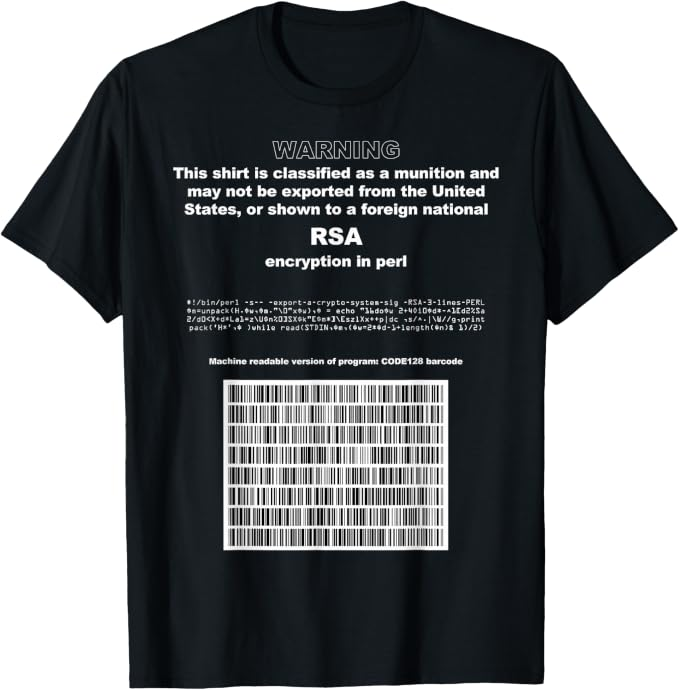
As a result of the Amazon report to the White House, export controls, a policy instrument first leveraged in the U.S. by Thomas Jefferson during the Napoleonic Wars, were slapped onto the software. This isn’t entirely new. The Crypto Wars of the 1990s saw similar restrictions placed on cryptography, legally classifying it as a munition.
As a form of protest, Adam Back (creator of Hashcash and cited in the Bitcoin whitepaper) distributed a t-shirt printed with lines of RSA encryption code and a warning that it was classified as a weapon and illegal to export from the U.S., or even to show to a foreign national.
We may be in the early stages of a similar story playing out. Only this time, 30 years later, the technology being put on trial is artificial intelligence.
Frontier AI can now write advanced mathematical proofs and run companies' back offices, yet what made the White House react within three days was the possibility that it might find and exploit bugs in critical codebases.
Cyber capability is no longer one risk category among many. It is the gating capability: the one thing that determines who gets access to the most powerful models on Earth.
That's the world Octane has been building for since day one.
What we're announcing
Octane has been approved under Anthropic's Cyber Verification Program (CVP): the formal vetting process through which Anthropic verifies legitimate security organizations and adjusts the safeguards on their accounts. Dual-use cybersecurity work that is blocked by default for the broader market – e.g. vulnerability exploitation, offensive security tooling, the raw material of real security research – is now unblocked for Octane, at the organization level, under Anthropic's monitoring and usage policy.
To be precise about what this is: it’s verification, not exemption. Genuinely malicious categories (like ransomware development or mass data exfiltration) stay blocked for everyone, including us. The program exists to separate organizations doing legitimate offensive-security research from everyone else. Anthropic reviewed what we do, how we do it, and why, and concluded that Octane belongs on the short list of organizations trusted to work with these capabilities.
“Security teams are entering a new regime. The strongest models are capable enough to matter, restricted enough that access now has to be earned, and dangerous enough that defenders can’t afford to work with one hand tied behind their back. This is exactly what we built Octane for: verified access to frontier capability, embedded inside a research pipeline that turns raw model intelligence into real vulnerabilities delivered to our users before attackers can exploit them.”
— Gio Vignone, Founder and CEO of Octane
Access is the floor, not the ceiling
But verified access alone doesn't find vulnerabilities. We ran that race already. Cold frontier models at maximum reasoning effort recovered about a third of the high-severity vulnerabilities Octane catches, because raw capability without security-specific context, orchestration, evaluation data, and researcher feedback is an engine without a chassis.
What verification changes is the ceiling. Every safeguard rejection, every request bounced to a weaker model, every capability held in reserve for the vetted few were taxes on the system we've built. They're now lifted. We have the strongest models, at full strength, inside the pipeline that already out-recovers them by fifty points of recall.
But attackers don't apply for verification programs. The Amazon bypass demonstrated that determined actors will squeeze offensive capability out of these models whether or not the front door is locked. And the leaders of the Five Eyes cybersecurity agencies recently urged organizations to integrate AI tools into their security operations immediately, as frontier AI changes cyber-risk assumptions “in months, not years.”
The gate is real now. The question for every company building mission-critical software is which side of it your security research runs on.
See what verified frontier capability looks like against real code: 0-Days in 72 Hours: How Octane Found Vulnerabilities in the Code Behind 99.7% of Browser Traffic.

Subscribe to our newsletter