Audit-grade at every step
Your code is continuously updated. It needs continuous security analysis.


%25201.avif)


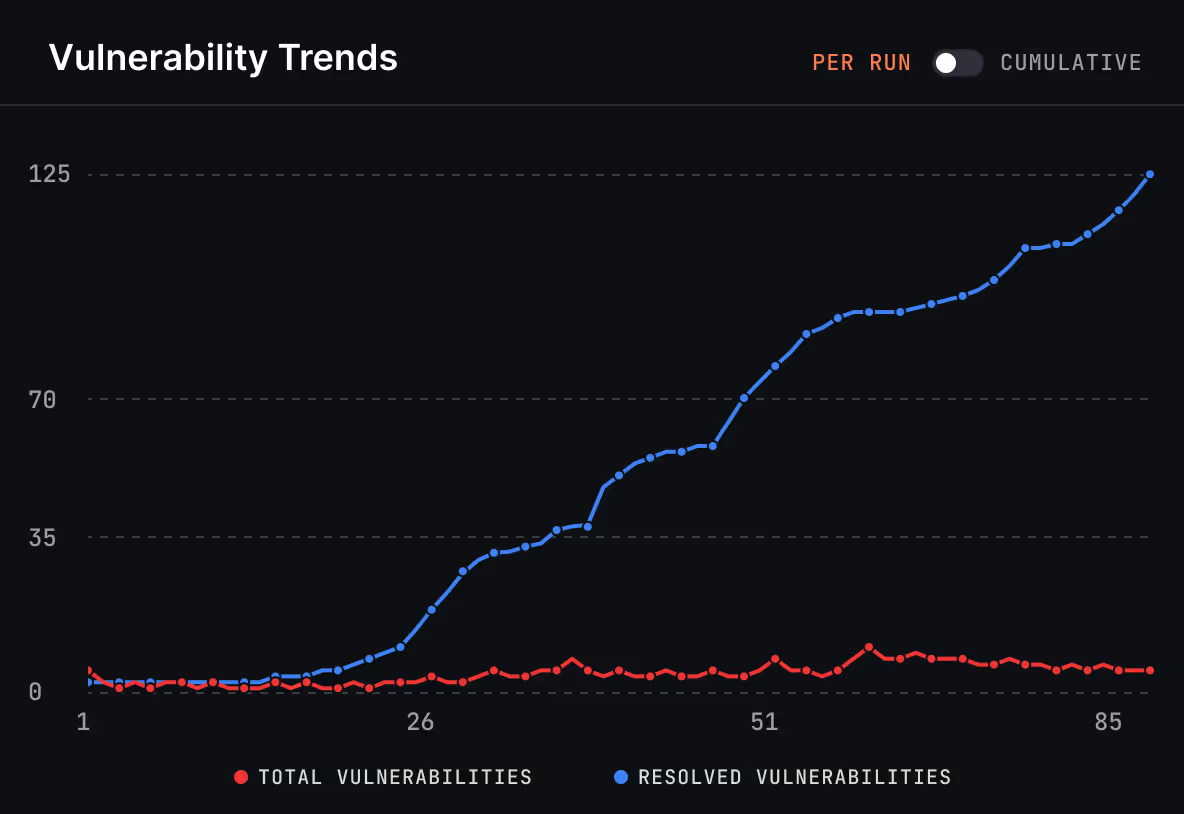
Octane's Continuous Analysis embeds agentic security directly into your CI/CD pipeline.
Every pull request gets audit-grade security review before it merges. Every commit triggers a fresh analysis.
Octane’s Continuous Analysis shifts your security left, catching bugs as soon as they’re introduced.
Velocity is now a security concern
New tooling means engineering teams are shipping faster than ever before. AI-assisted workflows deliver fresh code faster than any human team can review it. Velocity is a virtue, but haste is a vulnerability.
The window between a fresh commit and the next scheduled review is where bugs accumulate until an audit catches them weeks or months later - or until an attacker does first.

How Octane’s Continuous Analysis works

Integrate
Connect Octane to your repository, point it at the branches you want analyzed, and define the threat model you want enforced. Octane onboards the codebase, builds a structured context layer, and is working live in your pipeline before your next standup.

Analyze
Every pull request triggers a full analysis. Octane enumerates execution paths, traces cross-module interactions, and stress-tests invariants against the changes in the PR — not the surface a scanner would check, but the full attack surface a senior researcher would think about. Findings are ready within minutes of the PR being opened.
Surface
Findings appear inline on the pull request, classified by severity, with exploit path, root cause, and recommended remediation attached. Severity-routed alerts go to the channels your team specifies. Merge-gating is configurable to your risk tolerance.
What you get and when to choose Continious Analysis
Findings come with:
- A concrete exploit path
- A documented root cause
- A runnable proof of concept
- Actionable remediation guidance
Continuous Analysis is right for:
- Protocols and infrastructure that ship updates faster than manual audits can keep pace
- Active CI/CD pipelines where security review is currently a bottleneck or an afterthought
- Codebases with active third-party contributions where every PR carries unknown risk
- Mature security organizations adding a between-audits layer to a defense-in-depth posture
- Anywhere the cost of a vulnerability reaching production exceeds the cost of catching it pre-merge


Coverage you can commit to
Escalate to ARE when the cost of being wrong is too high for anything less than the most intensive analysis available
Our security program has always been built around defense in depth. We combine careful protocol design, professional audits, and a live bug bounty. What Octane adds is coverage between those controls: continuous analysis at the moment new code is introduced. That kind of continuous coverage fundamentally changes the economics of finding and fixing issues.
Octane… is equivalent to a world-class auditor.

Audits run on a calendar, but attackers don't.
Octane’s Continuous Analysis is what closes the security gap on every PR, with audit-grade findings.
Get Continuous Analysis in CI/CD
FAQ
Octane covers Ethereum and all EVM-compatible chains (Arbitrum, Optimism, Base, Polygon, BNB Chain), Solana, Aptos, Sui, and Cosmos-based chains, with additional networks added on a rolling basis. Coverage extends to Layer-2 rollups, cross-chain bridges, and protocol code at the validator and consensus layer – the surfaces where the largest losses have historically been concentrated.
Octane secures all mission-critical software from blockchains to browsers.
Octane is fully language agnostic. If you write code in it, Octane can analyze it.
Most teams are reviewing live Octane findings within hours, not weeks. Octane connects directly to your code repository, runs initial analysis on the existing codebase, and begins surfacing findings on every subsequent commit. No production access required. Full integration, including CI/CD connection and team onboarding, can be done in less than a day.
Octane validates every finding against the full execution context of your codebase rather than the file a flaw appears in. The platform traces whether a suspicious pattern is actually reachable, exploitable, and material — discarding findings that look risky in isolation but are constrained by upstream guards. Engineering teams receive a triaged list of real, exploitable issues instead of a flood of theoretical alerts.
Octane uses domain-specific AI agents purpose-built for security analysis to read code the way a senior auditor would. Octane traces data flow, models attacker behavior, and reasons about how functions interact across the full codebase. Unlike pattern-matching scanners, Octane evaluates business logic and protocol-specific intent, surfacing the kinds of vulnerabilities traditional tools miss because they require reasoning, not just rules.
A traditional smart-contract audit is a point-in-time human engagement – typically four to eight weeks long – that ends when the report is delivered. Octane is continuous: it reviews every commit, dependency change, and protocol upgrade with the same depth as a human auditor, but without the four-week latency or six-to-seven-figure per-engagement price tag. Most leading protocols pair Octane with human audits, treating Octane as the layer that catches what's introduced between review cycles.
Octane provides deeper insights than SAST or DAST tools by tracing vulnerabilities through your codebase to show you how they can be exploited. SAST tools rely on pattern-matching against known signatures and flood teams with low-context findings; DAST tools require a running application and miss anything not exposed at runtime. Octane reasons through business logic and full execution paths, surfacing the real, exploitable issues that matter. As such, Octane can replace your need for SAST and DAST tooling.
Halborn, Trail of Bits, OpenZeppelin, and ChainSecurity are human-led audit firms that engage on point-in-time projects. Octane is a continuous AI security platform. Many leading protocols pair the two: a respected human audit at major release milestones, and Octane in the background reviewing every commit, dependency, and upgrade in between. The role of Octane is to ensure the security posture you paid an auditor to certify does not decay between engagements.
Yes, and it's one of the most common reasons enterprise teams adopt Octane. AI assistants like GitHub Copilot, Cursor, and Claude Code now generate a substantial share of new commits, yet they frequently introduce subtle authentication, input-validation, and access-control flaws. Octane reviews AI-generated code with the same depth as human-written code, providing the continuous security review that AI-assisted development requires to ship safely.
Yes. Octane integrates natively with GitHub and GitLab, surfaces findings directly in pull requests, and plugs into CI/CD pipelines. Findings can be configured to block merges, comment on PRs, or feed downstream ticketing — meaning security review becomes part of every developer's existing workflow rather than a separate gate.
Yes. Every Octane finding includes a traced exploit path showing how the vulnerability would be reached, what an attacker would do to trigger it, and what assets would be at risk. Rather than flagging a line of code, Octane reconstructs the attack sequence end-to-end so engineering teams can prioritize by real impact and reproduce the issue in test before shipping a fix.